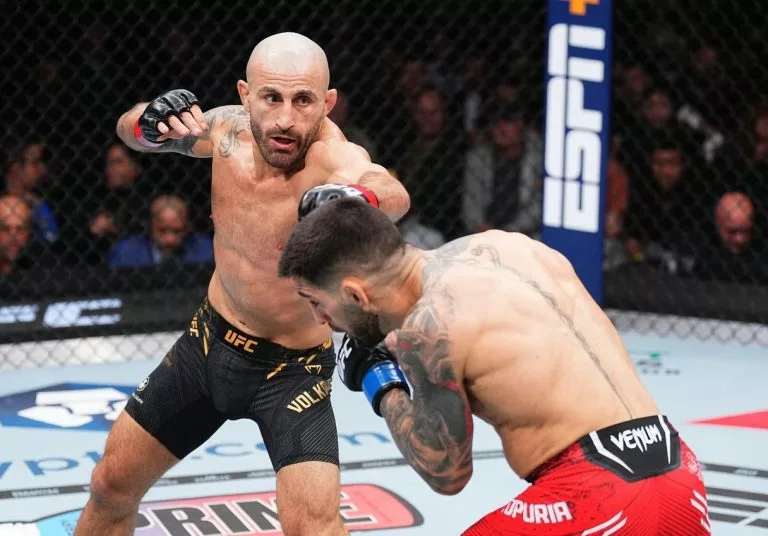
Credit: Chris Unger/Zuffa Images
Sometimes, your career doesn’t go as planned. Not only do I no longer work at my former employer, but all the evergreen studies and research findings I published about UFC advanced stats years ago are now gone.
Their legacy lives on, though.
This is the first-of-its-kind landing page for something I reference every week in my Prelims Primer and DFS projections.
Striking Success Rate (SSR) is called a lot of confusing things by other MMA math wizards. Sometimes, it’s referred to as “significant strike differential per minute” or “striking differential per minute”.
It’s all the same. I just coined this term years ago, even though it doesn’t perfectly fit the definition of “success rates” in football or basketball as we know it now.
You probably got here by clicking the link in my article. Welcome. Here’s a quick definition of SSR and why it matters.
What is “Striking Success Rate” (SSR)?
The concept of SSR is very simple.
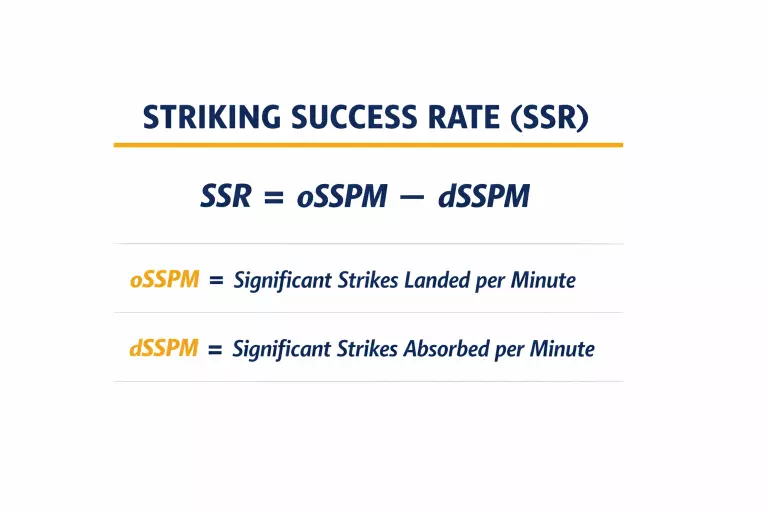
A fighter’s SSR is defined as the number of significant strikes they land per minute minus the number of significant strikes they absorb per minute. In its most plain form, it’s significant damage out minus significant damage in:
I refer to this stat as the ultimate “truth serum” in UFC statistics.
Volume can lie. In 2026, think of Jiri Prochazka. He lands 5.61 significant strikes per minute on frantic pace and pressure. However, he absorbs 5.67, which presents a pretty mediocre per-minute differential due to his well-documented defensive problems.
Here’s another fib. Islam Makhachev lands just 2.45 significant strikes per minute. Obviously, the pound-for-pound No. 1 is an elite fighter, and his +1.00 SSR shows that at a championship level before you get into the grappling danger he presents.
There are multiple ways to win UFC fights. This statistic accounts for the high-paced burners, the low-volume defensive tacticians, and the grappling wizards. If they’re elite, they’ll all look good here.
Why “Striking Success Rate” (SSR) Matters
How did I forecast Sean O’Malley, Joshua Van, Carlos Ulberg, and Tom Aspinall would lift UFC gold? How did I predict the downfall of Israel Adesanya and Leon Edwards?
I’m not a film junkie or a fortune teller. The proof is in the pudding when it comes to UFC success.
UFC’s basic stats profile includes significant strikes landed per minute (oSSPM), striking accuracy, significant strikes absorbed per minute (dSSPM), striking defense, takedowns landed per 15 minutes, takedown accuracy, takedown defense, and submission attempts per 15 minutes.
None of them passes multiple regression with any meaningful correlation to predict UFC risers and fallers. There are too many ways to skin a cat. However, this differential — derived from two of them — does. Just look at the SSRs for current UFC champions (as of June 2026):
| Division | Fighter | SSR |
| Flyweight | Joshua Van | +2.61 |
| Bantamweight | Petr Yan | +0.92 |
| Featherweight | Alexander Volkanovski | +2.68 |
| Lightweight | Justin Gaethje | -0.54 |
| Welterweight | Islam Makhachev | +1.00 |
| Middleweight | Sean Strickland | +1.45 |
| Light Heavyweight | Carlos Ulberg | +2.54 |
| Heavyweight | Tom Aspinall | +4.01 |
| Heavyweight (Interim) | Ciryl Gane | +3.09 |
| Women’s Strawweight | Mackenzie Dern | -0.46 |
| Women’s Flyweight | Valentina Shevchenko | +1.04 |
| Women’s Bantamweight | Kayla Harrison | +3.19 |
Of course, the UFC average — because across all of recorded statkeeping there’s been a significant strike absorbed for each landed — is +0.00. That can vary slightly on the current roster, but it’s a good baseline for performance.
Look at the exceptions. Justin Gaethje was, by all accounts, fortunate that Ilia Topuria (+0.95 SSR) took such a poor gameplan at The White House as the smaller man. Mackenzie Dern is, by all accounts, keeping the belt warm for Zhang Weili (+2.03).
There are no longterm exceptions in UFC history. The elite fighters in this sport all shine in this metric, yet it’s does not correlate on a competition-adjusted basis to betting lines as often as you’d think.
Applying “Striking Success Rate” (SSR)
You don’t need a predictive model like mine, which factors in SSR as a component, to bet on UFC. But, it has to be in the right sample.
Say we’ve got a fighter fresh off DWCS with a +4.50 SSR from a first-round knockout. We should bet that guy as a +200 underdog, right? Not exactly. That’s a weak sample.
If his opponent has a +0.81 SSR but is 1-2 in UFC, having faced two successful fighters, that’s actually a better indication of future performance, and the favored moneyline might be very appropriate — assuming there’s no cardio, grappling, or power advantages to factor in. That’s a “buy-low” spot on results versus in-fight performance.
Furthermore, you can often get a leg up on the “film bros” who love a guy’s “technique” or recent level of competition. Some guys might buy low on a fighter perceived to have very good technique, but if his SSR is -4.50, it doesn’t matter if that was against title challengers. That’s a bad striker.
Overall, this metric is worth a glance every week — especially in close fights or fights you’re not sure about. If you’re not watching box scores as carefully as I am, it might surprise you which fighter actually performed better over 15 minutes.
🔍 Want to know more about each event? Visit homeoffight.com or any of our social media accounts for more articles, fighter interviews, and plenty of additional coverage.
💰 Want to get in on the action? Visit homeoffight.com/picks to tail all of the Home of Fight expert’s picks & bets each week!